
 Brian's Empire KE
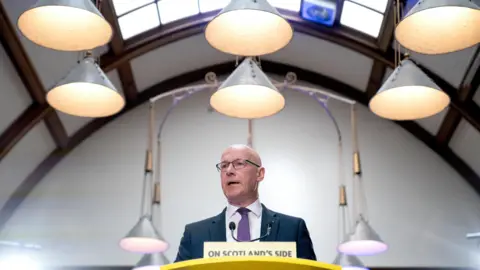
The big issues and key flashpoints from Scotland's election campaign This is the fifth national election that John Swinney has fought as leader of the SNP – and he's still looking for his first victory.
He lost the UK general election in 2024 to Labour, although it was his two immediate predecessors – Humza Yousaf and Nicola Sturgeon – who got the blame.
When Swinney last led the SNP in the early noughties the party lost ground in elections for Westminster 2001, Holyrood in 2003 and in the European elections in 2004.
The trend in opinion polls suggests that this contest could be different and that it may be fifth time lucky for Swinney.
If he wins, that would give the SNP their fifth consecutive term in charge of devolved public services such as the NHS, education and law and order.
It is interesting to look back at the SNP manifesto from 2003. Then, Swinney was asking for "the chance to prove ourselves".
That would eventually be granted – and after 19 years in power, the party is now trying to renew itself in office and prove that it still has the energy and ideas to govern.
 PA Media
These include queues for NHS diagnosis and treatment, overcrowded jails and new ferries that are seriously overdue and over budget.
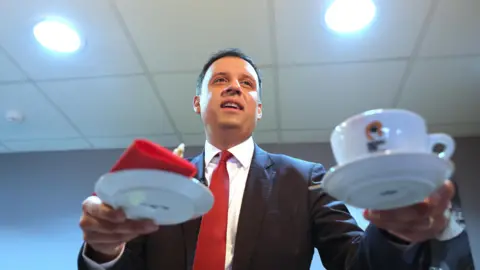
Labour's Anas Sarwar argues that the SNP has had its chance and is appealing for voters to "give me five" years to start fixing Scotland's problems.
It seems to me that he is offering new management rather than a major policy overhaul in most devolved areas.
His fundamental difference with the SNP remains the independence question, even if Labour's support for new nuclear power stations does offer an alternative dividing line.
 PA Media
That means public spending cuts or increased taxes, unless there are unexpected surges in either the grant from the UK Treasury or in economic growth.
Conservative leader Russell Findlay has repeatedly raised this issue in the election campaign alongside his party's plans to cut welfare spending.
He has also made clear that the Tories would want some savings used to fund income tax cuts.
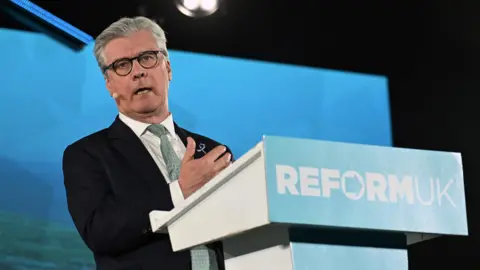
Reform UK's leader in Scotland, Malcolm Offord, wants bigger income tax cuts paid for by closing some public agencies and ending the push for a carbon-neutral economy by 2045.
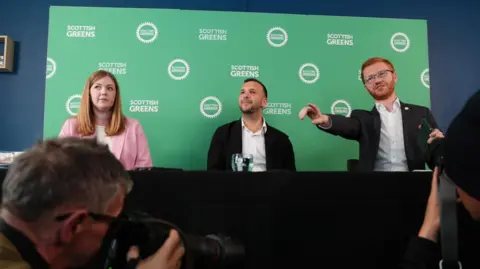
The Greens, under the co-leadership of Ross Greer and Gillian Mackay, want to tax wealthy people more to better fund public services and extend free bus travel to everyone.
Labour and the Liberal Democrats aspire to reductions when economic conditions allow. The SNP, which created the current six-band system, wants to simplify it.
Who should pay what in tax, and which welfare benefits should be funded from the Scottish government's budget, feels like one of the defining issues in this campaign.
The Greens and Reform represent opposite ends of the political spectrum – both trying to draw disaffected voters away from the more traditional, mainstream parties.
This was clearly illustrated in the STV leaders' debate when Offord revealed that he owns six houses, six boats and five cars due to his success in business.
He asked Greer if the Greens wanted more or fewer people like him in Scotland. Greer said fewer – and that Offord should give up homes to those without their own accommodation.
 PA Media
To be fair, all the larger parties have said that cutting health waiting times would be a priority for them – as it is for the public.
They have also vied to offer additional help with the cost of living, which has increased during this election contest with the war in Iran driving up fuel prices.
In the context of international conflict, there's been renewed debate about more oil and gas extraction from the North Sea. This is a Westminster decision but anyone can have a view.
US President Donald Trump has led calls for the UK to "drill, baby, drill" and the Conservatives and Reform UK share that viewpoint.
Scottish Labour wants the UK government to honour licences for the new Rosebank and Jackdaw fields, while the Lib Dems favour increased domestic production if it's less environmentally damaging than importing from elsewhere.
The SNP has appeared to soften previous resistance to new oil and gas developments during this campaign, with only the Greens remaining firmly opposed.
President Trump made a further intervention when he chose to lift import tariffs on whisky in honour of the King and Queen, who made a state visit to the US.
This was widely welcomed – but also prompted a political squabble over who could claim credit.
Labour insisted it was an example of the UK government delivering for Scotland, with the SNP bigging up John Swinney's role in lobbying the president directly.
A plan to address cost-of-living pressures produced one of the key policy clashes of the campaign.
The SNP proposed a new law to require supermarkets to limit the cost of a certain basket of essential goods.
This would take time to enact and would push the limits of Holyrood's powers because UK internal market rules offer Westminster a veto.
Retailers dismissed the idea as a "potty gimmick" and the SNP's political rivals took their cues from there.
One SNP source suggested they were "annoying all the right people".
 PA Media
The early part of the campaign was dominated with stories about the personal conduct of candidates and other political figures.
Later, the re-emergence of the row over the appointment and sacking of Peter Mandelson as UK ambassador to the US diverted much political attention from the Scottish campaign.
That was a reminder of why Anas Sarwar called for the prime minister to resign and why he appears to feel justified in having done so.
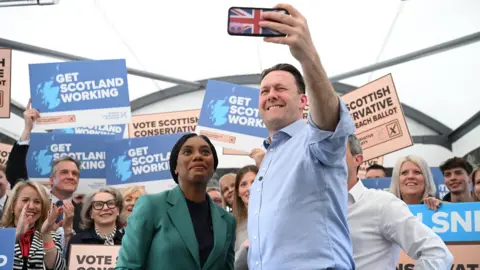
Starmer has yet to make a campaign visit to Scotland and seems unlikely to do so. His brief prime ministerial stop at the Faslane naval base does not really count.
 PA Media
The Scottish Greens had the leader of their sister party in England and Wales, Zack Polanski, lending them support.
Labour argues that there is still a pathway to ousting Swinney from office, despite national opinion polls suggesting the SNP is well ahead.
Is it possible that these polls are not adequately capturing local and regional differences or any mismatch between those who respond to surveys and those who actually turn out to vote?
Labour certainly insists that its own canvassing data from mostly central belt constituencies tells a very different story.
 PA Media
They would first need to sort out their own differences and unite behind a candidate for first minister.
That may be difficult given that the single biggest flashpoint in the campaign was a clash in the Channel 4 leaders debate between Labour's Anas Sarwar and Reform UK's Malcolm Offord.
Offord claimed Sarwar had privately suggested they work together to oust the SNP. Sarwar accused him of lying and both appeared to rule out co-operation.
After every previous Holyrood election, the leader of the largest group of MSPs has become first minister but there is no rule that prevents the election of another candidate if they can command greater support.
That is for 8 May and beyond, when the votes have been counted and the parliamentary arithmetic reveals who is best placed to take charge of the Scottish government for the next five years.

We have compiled a simple summary of where the main parties stand on the issues most important to voters, based on the promises they have made during the election campaign.
Click on this link – Who should I vote for? Compare party policies – and select an issue to see their policies.
You can also use the postcode search below to find out who is standing in every seat at the election on 7 May.
Support Everyday Chronicle
Global reporting requires independent voices. If you value our coverage, please consider a small contribution to help us grow.
Click the button below to make a secure donation
Discover more from Everyday Chronicle
Subscribe to get the latest posts sent to your email.
Have any thoughts?
Share your reaction or leave a quick response — we’d love to hear what you think!
-
 0
0
-
 0
0
-
 0
0
-
 0
0
-
 0
0
-
 0
0
